The Long & Short of It: Software's Reckoning—When AI Eats Its Parents
February 8, 2026
The software industry is experiencing an existential crisis. Traditional SaaS giants that once promised infinite scalability and recurring revenue are now watching their business models crumble under the weight of the very technology they helped create: artificial intelligence. Meanwhile, AI-native companies are raising unprecedented capital and rewriting the rules of enterprise software. For investors using automated trading systems and systematic portfolio management strategies, this disruption presents both peril and opportunity.
The Great Software Selloff
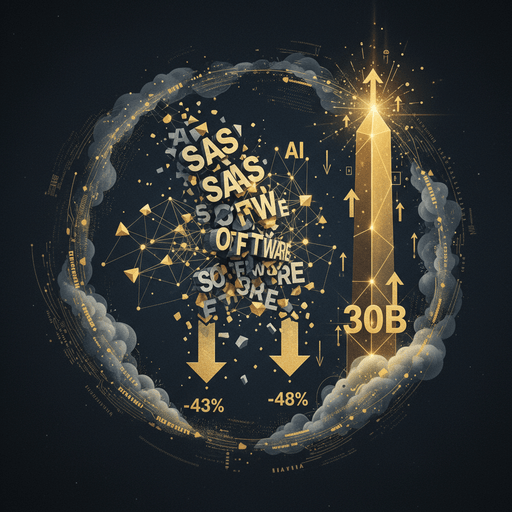
This week delivered a sobering reality check for software investors. US software stocks tumbled dramatically, underperforming the S&P 500 by nearly 24 percentage points—a divergence not seen since the dot-com bust. Salesforce, once the darling of cloud computing, has plummeted 43% over the past twelve months. ServiceNow, another enterprise software titan, has cratered 48% during the same period.
The culprit? Artificial intelligence is fundamentally disrupting the subscription software model that powered two decades of growth. When a single AI agent can replace entire software suites—automating tasks that once required multiple SaaS subscriptions—the value proposition of traditional enterprise software evaporates. This is not a temporary correction; it is a structural shift that robo trading algorithms and copy trader systems must account for in their risk models.
Options traders are bracing for continued volatility, with put-call ratios spiking across the software sector. The message is clear: the market expects more pain ahead for legacy SaaS companies. For those managing separately managed accounts (SMAs) or operating SMA hedgefunds, the time to reposition portfolios away from vulnerable software names is now—not later.
Anthropic's $30 Billion War Chest
While traditional software companies hemorrhage market value, AI-native firms are attracting capital at a staggering pace. Anthropic, the AI research company founded by former OpenAI executives, just closed a $30 billion funding round—co-led by D.E. Shaw Ventures and other top-tier investors—valuing the company at an eye-watering $380 billion.
To put this in perspective: Anthropic's valuation now exceeds that of Salesforce, despite having a fraction of the revenue. This is not irrational exuberance; it is a calculated bet on the future of enterprise technology. McKinsey estimates that $7 trillion will be spent on AI infrastructure over the coming years, and investors are positioning early to capture that growth.
Anthropic's Claude AI platform is already displacing traditional software in key enterprise workflows—from customer service automation to document analysis and code generation. Unlike legacy SaaS products that charge per-seat or per-module, AI platforms offer horizontal capabilities that can replace entire software stacks. This is why algorithmic trading systems are rotating capital from old-guard software into AI infrastructure plays.
The Long & Short of It
For investors leveraging mirror trading strategies or portfolio automation tools, the investment thesis is straightforward:
LONG: AI Infrastructure & Native Platforms
Nvidia (NVDA) remains the picks-and-shovels play on AI infrastructure. Every dollar Anthropic spends on compute flows through Nvidia's GPUs. With AI spending accelerating, Nvidia's data center revenue is poised for continued growth. The stock has consolidated after its meteoric rise, offering a more attractive entry point for systematic trading strategies.
Palantir Technologies (PLTR) is uniquely positioned as an AI-native software platform that integrates with existing enterprise systems. Unlike traditional SaaS companies facing disruption, Palantir's Artificial Intelligence Platform (AIP) is the disruptor. The company's government and commercial contracts are expanding as organizations seek AI-powered decision-making tools.
Amazon (AMZN) Web Services (AWS) is the infrastructure backbone for AI workloads. As Anthropic and other AI companies scale, AWS captures the compute, storage, and networking revenue. Amazon's recent investments in custom AI chips (Trainium and Inferentia) position it to compete directly with Nvidia in the long term, offering margin expansion potential.
SHORT: Legacy SaaS & Disrupted Software
Salesforce (CRM) faces a brutal reality: AI agents can automate much of what Salesforce's CRM platform does manually. The company's belated pivot to AI (with Einstein GPT) feels reactive rather than visionary. With revenue growth decelerating and customer acquisition costs rising, Salesforce is a prime candidate for robo trading systems to short or underweight.
ServiceNow (NOW) built its business on IT service management workflows—precisely the type of repetitive, rules-based tasks that AI excels at automating. While ServiceNow is attempting to integrate AI, its legacy architecture and pricing model are ill-suited for an AI-first world. The 48% decline over the past year may have further to run.
Legacy Data Center REITs are also vulnerable. As AI workloads demand specialized infrastructure (liquid cooling, high-density power, proximity to renewable energy), older data centers become obsolete. Companies like Digital Realty Trust (DLR) and Equinix (EQIX) face significant capital expenditures to retrofit facilities—or risk losing tenants to purpose-built AI data centers.
Implications for Systematic Traders
For those operating automated trading systems or managing separately managed accounts with quantitative strategies, this software-to-AI transition offers actionable signals:
-
Sector Rotation: Algorithms should be programmed to rotate out of traditional software (SAAS ETFs, IGV) and into AI infrastructure (BOTZ, ROBO, IRBO). The momentum has shifted, and trend-following strategies will benefit from riding this wave.
-
Volatility Harvesting: The software sector's elevated volatility creates opportunities for options strategies. Selling covered calls on legacy software holdings can generate income while waiting for positions to recover (or decay further). Conversely, buying call spreads on AI infrastructure names offers leveraged upside with defined risk.
-
Factor Tilts: Traditional "quality" and "growth" factors that favored SaaS companies are now liabilities. Algorithmic rebalancing should emphasize "innovation" and "disruption" factors, which favor AI-native companies with negative earnings but exponential revenue growth potential.
-
Risk Management: The correlation between software stocks is breaking down. Salesforce and ServiceNow are declining while Palantir and C3.ai rally. Portfolio construction must account for this dispersion—blanket tech exposure is no longer sufficient. Systematic portfolio management requires granular sector and subsector allocations.
The Vetta Edge
At Vetta Investments, our V-Rank Alpha model portfolio is designed to capitalize on exactly these types of structural market shifts. By systematically identifying companies with superior growth characteristics and rotating out of those facing headwinds, our rules-based investing approach avoids the emotional pitfalls that trap discretionary managers.
Our proprietary algorithms analyze over 900 mid- and large-cap stocks monthly, ranking them on momentum, quality, and growth factors. When software stocks began underperforming in late 2025, our system automatically reduced exposure—protecting capital before the February selloff. Conversely, as AI infrastructure names demonstrated sustained outperformance, our model increased allocations, capturing the upside.
This is the power of quantitative trading combined with disciplined rebalancing. Human investors struggle to overcome recency bias and loss aversion; systematic strategies do not. Whether you are exploring copy trader platforms, evaluating mirror trading services, or considering a separately managed account, the key is finding a strategy that adapts to changing market conditions without emotional interference.
What's Next?
The software-to-AI transition is still in its early innings. Expect more legacy SaaS companies to issue profit warnings as AI-driven automation reduces customer spending. Simultaneously, AI infrastructure spending will accelerate, creating a widening performance gap between winners and losers.
For investors, the playbook is clear: short the disrupted, long the disruptors. But executing this strategy requires discipline, speed, and systematic risk management—qualities that automated trading systems excel at delivering.
Ready to Leverage Systematic Strategies?
Vetta's V-Rank Alpha model portfolio has delivered consistent outperformance by identifying market shifts before they become consensus. Our algorithmic trading approach removes emotion and captures opportunities that discretionary investors miss.
View our 20+ year performance track record → [blocked]
Subscribe to "The Long & Short of It" and receive market analysis, emerging technology insights, and systematic trading strategies every Tuesday, Thursday, and Saturday. Join sophisticated investors who stay ahead of disruption.
Subscribe free—no spam, unsubscribe anytime [blocked]
Disclaimer: This newsletter is for educational and informational purposes only and does not constitute investment advice. Past performance does not guarantee future results. All investments involve risk, including the potential loss of principal. The companies mentioned are for illustrative purposes and do not represent specific investment recommendations. Consult with a qualified financial advisor before making investment decisions.
SEO Keywords: Copy Trader, Automated Trading, Mirror Trading, Separately Managed Accounts, Robo Trading, SMA Hedgefund, Algorithmic Trading, Portfolio Automation, Systematic Trading, Rules-Based Investing, Quantitative Trading, Algorithmic Rebalancing, Systematic Portfolio Management
Related Articles
Silicon Sunset, Neurons Rising
The financial world is experiencing a seismic shift that most investors haven't fully grasped yet. While headlines trumpet the Dow's historic 50,000 milestone, two revolutionary forces are quietly res...
The Silicon Alchemists: Forging Tomorrow's Brains from Bits
Monday, March 16, 2026 | Vetta Investments — News & Insights --- The air on Wall Street, usually thick with the scent of ambition and artisanal coffee, now carries a faint, almost imperceptible hum. It's the sound of servers whirring, of data flowing, of algorithms thinking. We're not just trading...
The Digital Fortress: Building Walls in the Age of AI and Cyber Shadows
Monday, March 16, 2026 | Vetta Investments — News & Insights --- The digital world, for all its boundless promise, has always been a bit like the Wild West: vast, untamed, and rife with both opportunity and peril. Today, however, the landscape is less about dusty trails and more about...
Comments (0)
Share your thoughts and join the discussion. All comments are moderated.
No comments yet. Be the first to share your thoughts!
Get More Insights Like This
Subscribe to The Long & Short of It and receive market analysis, emerging technology insights, and investment opportunities every Tuesday, Thursday, and Saturday.
Free newsletter. Unsubscribe anytime. We respect your privacy.